
Catching deepfakes in motion, not in a single frame
A hybrid CNN–Transformer that reads short video clips instead of one image at a time — learning the temporal tells of synthetic faces that frame-level detectors miss.
Why one frame isn’t enough
Deepfake generation has advanced to the point where a single synthesized frame can look flawless, making frame-by-frame detection increasingly unreliable. This project pairs the spatial feature extraction of EfficientNet-B0 with the temporal modelling of a multi-head self-attention Transformer. Instead of classifying individual frames, the model processes short clips of 8 consecutive frames. A learnable classification (CLS) token is prepended to the sequence and, after a 4-layer / 8-head Transformer encoder, produces a global temporal summary used for the final REAL / FAKE decision. Evaluated on FaceForensics++ C23 against a single-frame CNN baseline with the same backbone, the temporal model lifts ranking quality (AUC-ROC) substantially — and its attention weights reveal which frames drove each decision, giving the interpretable evidence digital-forensics work demands.
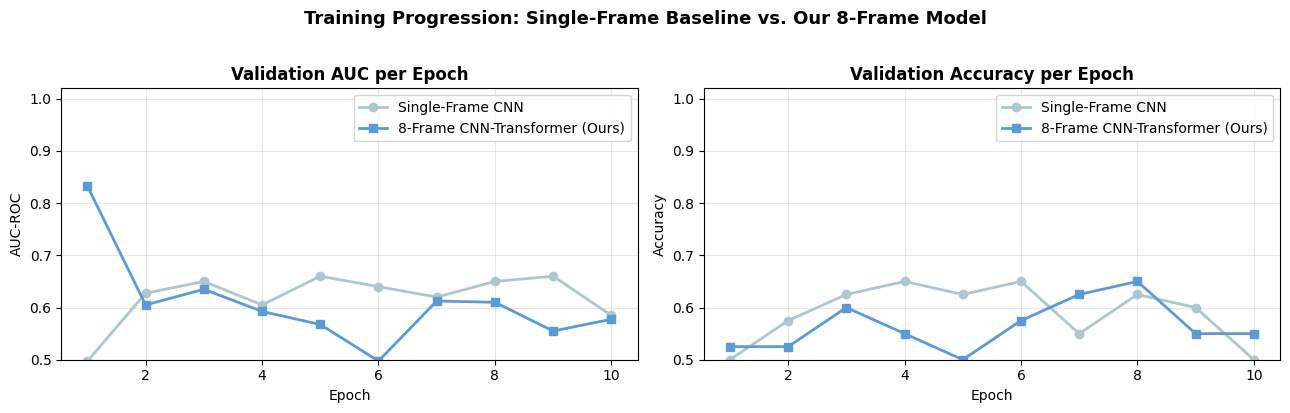
8-frame temporal model vs. single-frame baseline
Same EfficientNet-B0 backbone, same data, same training budget — the only change is whether the model sees one frame or eight. Best validation scores shown.
From pixels to a temporal verdict
Four stages turn a raw clip into an interpretable REAL / FAKE decision.
SPACE What each frame contains
EfficientNet-B0 is a compact, accurate CNN that extracts appearance features — edges, textures, and facial detail — from every individual frame.
TIME How frames relate
The Transformer’s self-attention compares all 8 frames at once, surfacing the temporal inconsistencies — blinking, flicker, texture drift — that only appear in motion.
Built by CS511 · Cyber Security
Master of Science in Cyber Security — College of Engineering & IT, University of Dubai.
Supervised by Dr. Hussam Al Hamadi — Program Director, MSc Cyber Security · Head, Cyber-Security & Applied Resilience Center (C-SAR).
Report & code
Full technical report and the training / evaluation notebook.
The model is trained on the FaceForensics++ dataset, released under its own academic-use license. Dataset videos and trained weights are not redistributed here; the notebook reproduces results once FaceForensics++ access is obtained.